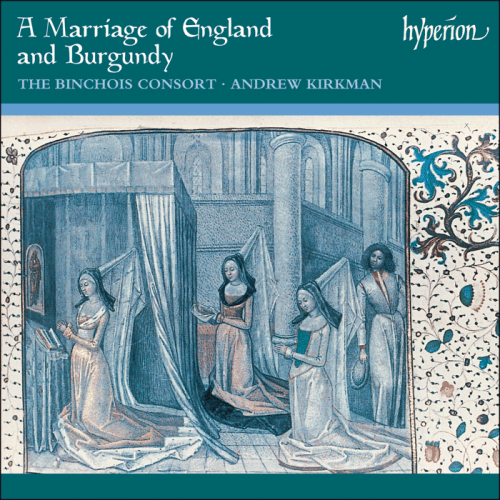
• The celebrations surrounding the marriage in 1468 of Margaret of York, sister of Edward IV of England, and Charles the Bold, Duke of Burgundy, constituted one of the undisputed pinnacles in the history of the Court of Burgundy. To judge from the extent and enthusiasm of surviving testimony, outstripping those of any similar 15th-century state occasion, this was the marriage of the century. It was also an opportunity for display on a grand scale with numerous musical events and celebrations.

    Although we don't know exactly what was performed, there is a manuscript—the 'Burgundian Court manuscript'—whose contents may well have been performed at ceremonies associated with the wedding. Some of the music from this manuscript, such as that by Antoine Busnois (an employee of the Court of Charles the Bold) is performed on this disc.

    Digital booklet (PDF)
  • This is a glorious disc: superb performances of truly wonderful music.

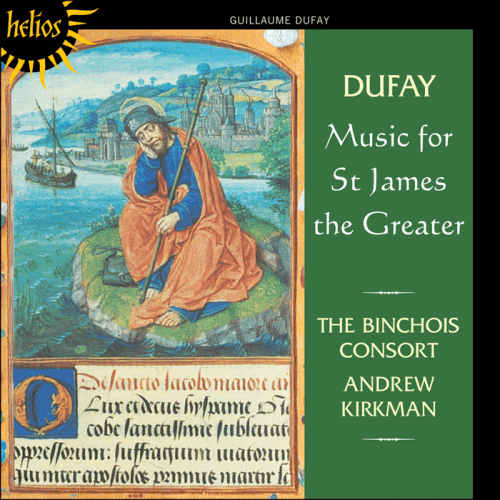
    St James the Greater, Apostle of Christ, foster son of the Virgin Mary, brother of St John the Evangelist, and indelibly—if somewhat perplexingly—associated with Compostela, became the focus of many composers; after all, anyone who was anyone in the Middle Ages (including Chaucer's Wife of Bath) would make a pilgrimage to St James's shrine in Spain at some point in their life. The exact background to Dufay's Mass is as yet unknown but it is an enormous work (forty minutes plus) of great passion.

    Also included on this disc are three motets composed around the same time as the Mass, and a Gloria/Credo pairing, remarkable for up-beat, if irreverent, interpolations of snippets from Italian and French popular songs during the 'Amens'.

    Digital booklet (PDF)

  • It is not known why Guillaume Dufay devoted so much of his creative endeavour to his 'patron saint', Anthony of Padua, but the resulting Mass (consisting of the 'Ordinary' movements along with five further motets with texts in praise of Anthony) remains one of the most extraordinary works of polyphony of the period. Dufay's will ordained the Mass to be performed in supplication for his soul each year, a practice apparently continued until the great cathedral at Cambrai was demolished in 1796.

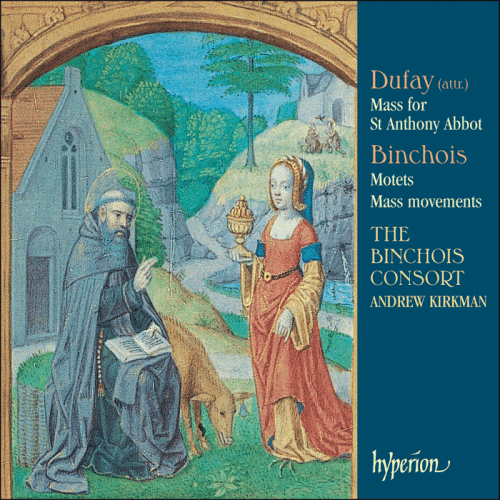
    This is a highly virtuosic piece: the rhythmic complexities in its Gloria and Credo, in particular, guaranteed it the attention of theorists for decades after its composition. The Mass is joined on this recording by the motet O proles Hispaniae which was also composed with St Anthony in mind and whose text is beneath the image of the Saint in the Flemish miniature on the disc's front cover.

    Digital booklet (PDF)

Go to Top