-
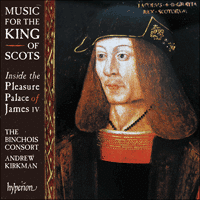
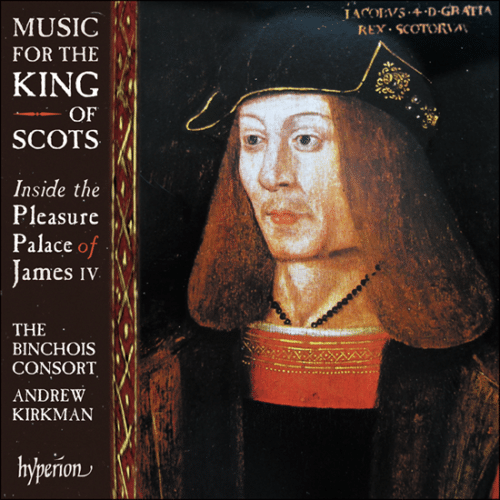 Recording details: September 2019 AudioLab, Genesis 6, Heslington, York, United Kingdom Produced by Philip Hobbs Engineered by Philip Hobbs Release date: 2 April 2021 Total duration: 55 minutes 17 seconds Cover artwork: Portrait of James IV of Scotland (1473-1513) (? 17th century). National Galleries of Scotland, Edinburgh
 -
 Recording details: May 2017 Ascot Priory, Berkshire, United Kingdom Produced by Adrian Peacock Engineered by David Hinitt Release date: 27 July 2018 Total duration: 72 minutes 47 second
 -
 Recording details: January 2016 Ascot Priory, Berkshire, United Kingdom Produced by Adrian Peacock Engineered by Andrew Mellor Release date: 31 March 2017 Total duration: 76 minutes 25 seconds Cover artwork: The Battle of Najera, 1367 (Fr 2643 f.312v, from Froissart’s Chronicle). French School, 15th century / Bibliothèque nationale, Paris / Bridgeman Art Library, London
 -
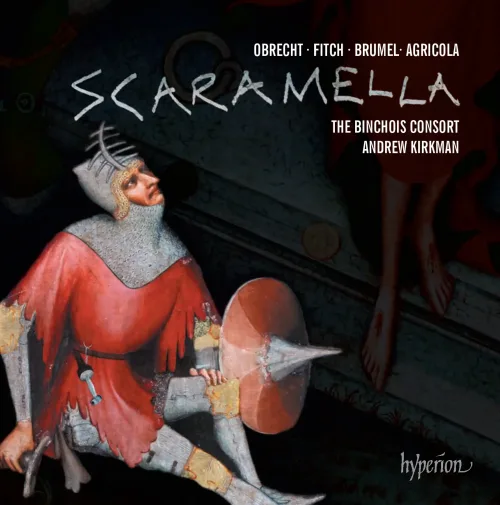 Our new album is the culmination of much hard detective work: Fabrice Fitch has recreated the two missing parts of Obrecht’s Missa Scaramella, only two of whose four voices survive (in partbooks) today. The achievement is sensational, and a fabulous tribute to our long-time collaborator Philip Weller, who began the project and who sadly passed away before it could be completed.
Added to the Mass are two further pieces completed by Philip: Brumel’s Philippe qui videt me, and the stunning Mater Patris by Obrecht. Fabrice’s own Planctus, written in memory of our dear friend. plus a motet by Agricola and the two surviving songs on Scaramella, round off the recital. We hope you will get as much out of hearing this as we all have creating it! -
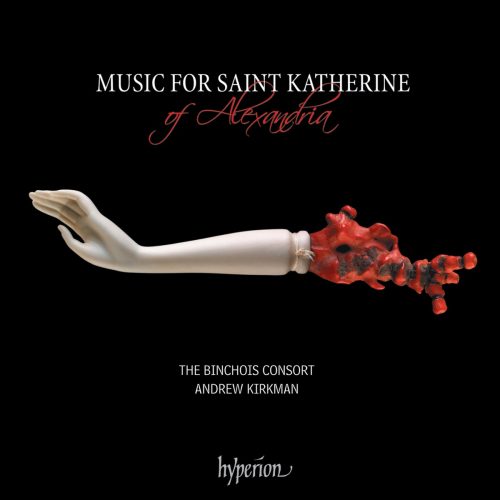 Label: Hyperion Recording details: May 2018 Ascot Priory, Berkshire, United Kingdom Produced by Adrian Peacock Engineered by David Hinitt Release date: June 2019 Total duration: 66 minutes 13 seconds Cover artwork: Tourniquet—upper arm (2007) by Sarah Danays
 -
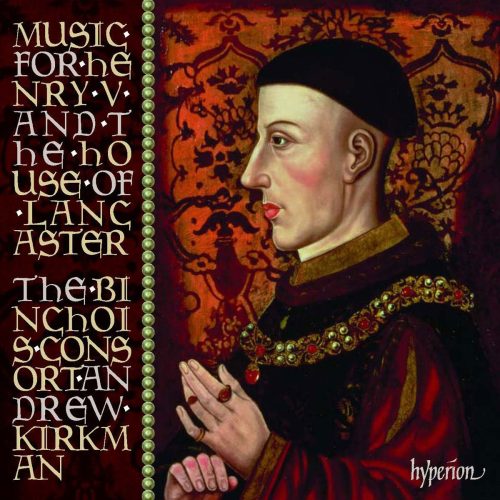 Recording details: May 2010 St Silas the Martyr, Kentish Town, London, United Kingdom Produced by Adrian Peacock Engineered by David Hinitt Release date: September 2011 Total duration: 72 minutes 39 seconds
 -
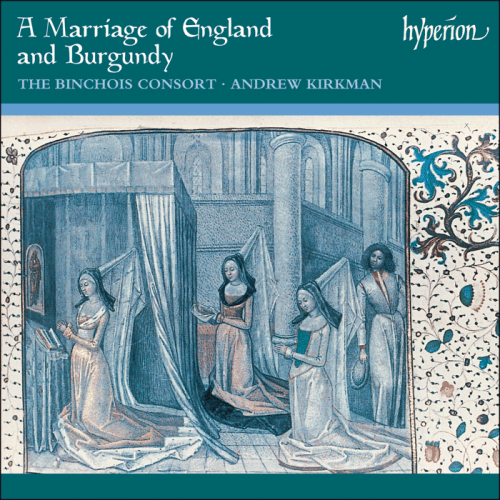
The celebrations surrounding the marriage in 1468 of Margaret of York, sister of Edward IV of England, and Charles the Bold, Duke of Burgundy, constituted one of the undisputed pinnacles in the history of the Court of Burgundy. To judge from the extent and enthusiasm of surviving testimony, outstripping those of any similar 15th-century state occasion, this was the marriage of the century. It was also an opportunity for display on a grand scale with numerous musical events and celebrations.
Although we don't know exactly what was performed, there is a manuscript—the 'Burgundian Court manuscript'—whose contents may well have been performed at ceremonies associated with the wedding. Some of the music from this manuscript, such as that by Antoine Busnois (an employee of the Court of Charles the Bold) is performed on this disc.
Digital booklet (PDF) -

Josquin is one of those composers like Lalande (or De la Lande, Delalande) whose name we're never sure how to spell. Should it be Josquin Desprez, Josquin des Prez or Josquin des Prés. So we generally just call him Josquin. A Frenchman, Grove describes him as 'one of the greatest composers of the entire Renaissance and certainly the most important before the latter half of the sixteenth century'. Scholarship has revealed that much music ascribed to Josquin was in fact by other composers using his name and fame. On the other hand there is also much which he could have written but is not authenticated.
This disc by the award-winning Binchois Consort assembles some sublime music certainly by Josquin, and also works which may or may not be by his contemporaries.
-

The Binchois Consort and Andrew Kirkman are now recognized as being the foremost interpreters of music by the father of polyphony that is Guillaume Dufay; their recordings of the Missa Puisque je vis and of Music for St Anthony of Padua were warmly received around the world, while the programme Music for St James the Greater won a Gramophone award.
-
 '...this gloriously performed disc from the eight male voices of the pure-toned Binchois Consort. Contrasting motets and mass propers, works of sublime clarity, are rewardingly interspersed. Who knows - or cares - whether it's even faintly authentic. The results are mesmerising' (The Observer)
 -

This recording contains the Missa Puisque je vis, almost certainly by Dufay, and Compère’s Omnium bonorum plena written in praise of the Virgin Mary, as well as motets by Dufay and other sources, all of which help colour our increasing awareness of the florid richness and emotional devotion of music before Baroque, till recently the starting point of most people’s awareness of the art. Characteristics of Dufay are his intricate workmanship and the development of independent balance among the vocal parts that lead us naturally to the satisfying clarity which has itself given old music a strangely contemporary feel.
The Binchois Consort, under their founder Andrew Kirkman, has a special affinity with the music of Dufay, for it was to perform Dufay that the ensemble was initially founded. That first outing formed the basis of their continuing award-winning exploration on Hyperion of 15th-century music, in particular the worlds of French and English music during the so-called Burgundian period.
-
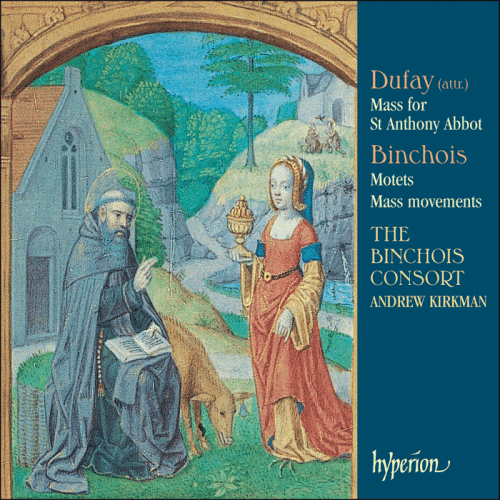
It is not known why Guillaume Dufay devoted so much of his creative endeavour to his 'patron saint', Anthony of Padua, but the resulting Mass (consisting of the 'Ordinary' movements along with five further motets with texts in praise of Anthony) remains one of the most extraordinary works of polyphony of the period. Dufay's will ordained the Mass to be performed in supplication for his soul each year, a practice apparently continued until the great cathedral at Cambrai was demolished in 1796.
This is a highly virtuosic piece: the rhythmic complexities in its Gloria and Credo, in particular, guaranteed it the attention of theorists for decades after its composition. The Mass is joined on this recording by the motet O proles Hispaniae which was also composed with St Anthony in mind and whose text is beneath the image of the Saint in the Flemish miniature on the disc's front cover.

Hear us/See us
Reviews / Commentaries
Social
©The Binchois Consort 2024 | Powered by FL1 Digital